What this means for Donyell
The lab never tied Donyell to the killing. No blood in the camper. No DNA on the gun the State called the murder weapon. The bullet matches a brand of gun, not a gun, and no test of Brown’s own gun against it appears in any record we have.
In my words
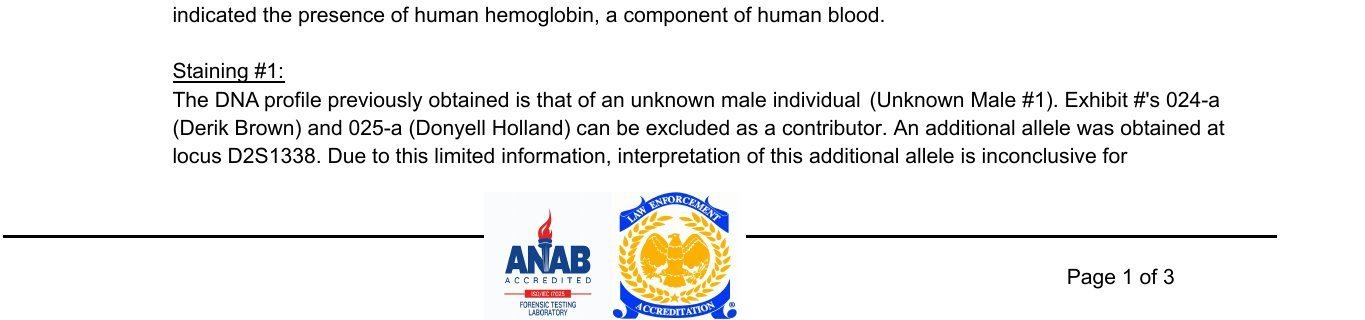
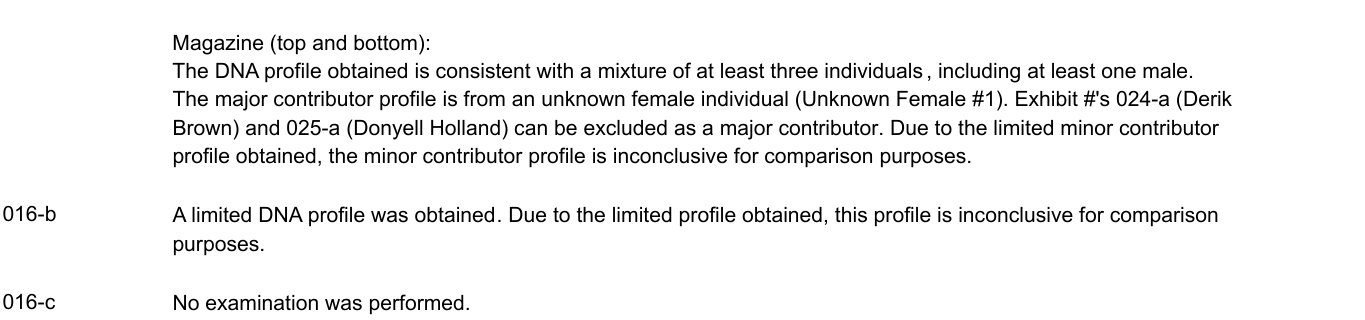
I gave my DNA. So did Derik Brown. Here is what the Tennessee Bureau of Investigation found, in its own reports.
Donyell Dewayne Holland
The three TBI reports (Lab Case 201012860)
- October 30, 2020Blood on the towel, trunk mat and board from Randall’s car comes from Unknown Male #1. Blood on the knife and papers from Stockton Drive comes from a different man, Unknown Male #2. The camper cushion and ottoman test negative for blood.TBI report, Oct. 30, 2020
- December 15, 2022After DNA standards from Donyell and Derik Brown reach the lab (October 4, 2022), both men are excluded as Unknown Male #1 and Unknown Male #2 on every item.TBI report, Dec. 15, 2022
- February 21, 2023TBI DNA (biology) report. For the red SCCY pistol the State called the murder weapon, the DNA unit wrote “No examination was performed” on the pistol itself; its swab is “inconclusive for comparison.” For the “Bullet from Randall Leslie,” the DNA unit also wrote “No examination was performed.” This is a DNA report only; the bullet and pistol did go through a separate TBI firearms exam (Exhibit 53), covered in Chapter 13. The only result with Donyell as the major DNA contributor is a swab of the Canik, a different gun the State did not call the murder weapon.TBI report, Feb. 21, 2023
One limit, stated plainly: the TBI reports show no reference sample from Randall Leslie himself, and the family reference collected from his mother on June 15, 2020 is marked “No examination was performed,” so the lab never said whether Unknown Male #1 is Randall. A second limit: a DNA exclusion means the DNA on that item did not come from that person. On its own it does not identify who shot Randall, and the DNA results are separate from the firearms results below.
TBI forensic biology report, Oct. 30, 2020TBI forensic biology report, Dec. 15, 2022TBI forensic biology report, Feb. 21, 2023The firearms
At trial, the TBI firearms examiner testified that the bullet matched the SCCY on class characteristics only; its individual marks were too damaged for a more conclusive result. No test of Brown’s Smith & Wesson 9mm against the bullet appears in any record we have. The examiner, TBI Special Agent Denver Hall, said some guns he did not test-fire: he “opened and examined” them and looked “down the barrel,” and when the rifling pattern differed from the bullet’s, “no further examinations were performed” (Tr. 2.3 @01:10:53-01:11:22). He said the Smith & Wesson has five-right rifling and the bullet seven-right (Tr. 2.3 @01:20:08-01:20:33). ATF held Brown’s gun and the bullet together from January 2021: no result appears in any record we have. Whether it was test-fired is not clear from the record: the trial audio’s machine transcript (being checked) has the examiner saying he test-fired “Exhibits 18A and exhibit 26A,” and on TBI’s own list 026-a is a Lorcin, not the Smith & Wesson.
Gun evidence and the ATF NIBIN leadFingerprint (AFIS) examination reportsMedical examiner and forensic recordsThe lab reports, in their own words